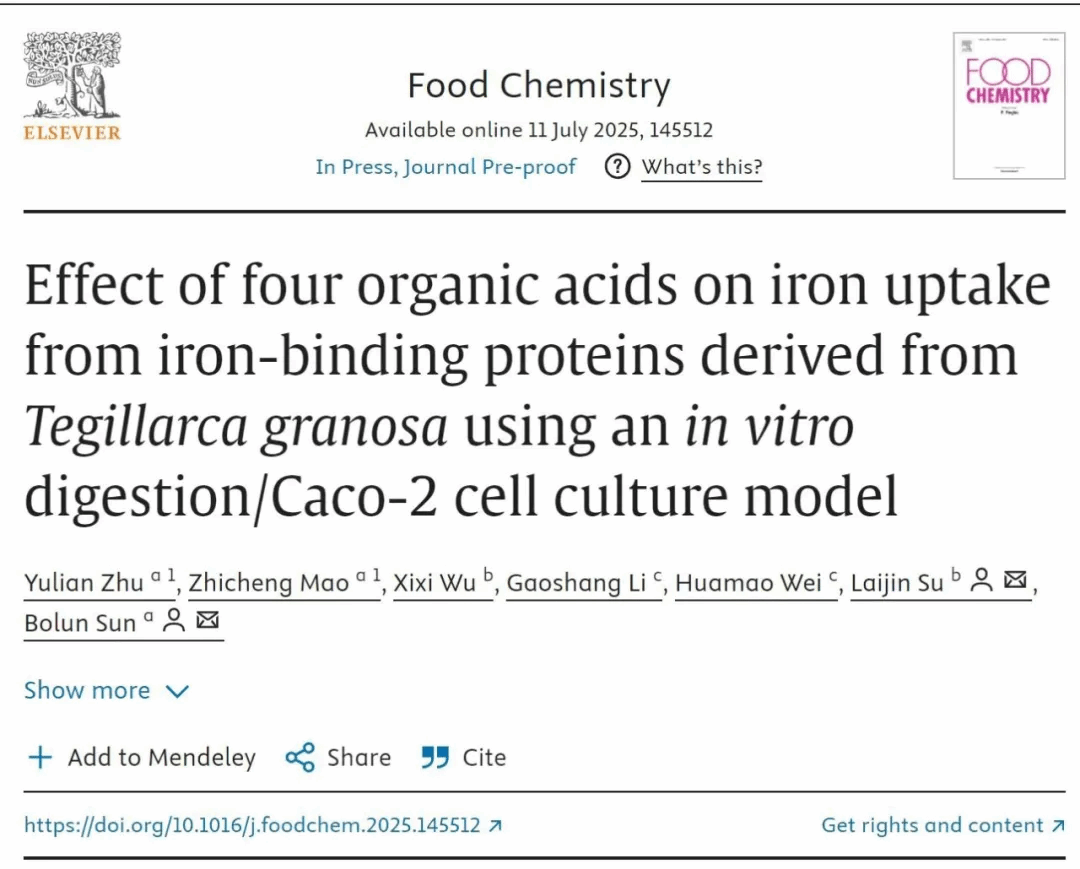
Recently, two second-year undergraduate students majoring in Nursing from our school, Zhu Yulian and Mao Zhicheng, published a research article titled "Effect of four organic acids on iron uptake from iron-binding proteins derived from Tegillarca granosa using an in vitro digestion/Caco-2 cell culture model" in Food Chemistry, a top international journal of nutrition (CAS Category 1 TOP, IF=9.8), as the first author and co-first author respectively. The article was supervised by Dr. Sun Bolun, a young teacher newly recruited by our school in recent years.
Iron deficiency anemia is a common clinical nutritional disorder that has attracted global attention. Dietary iron supplementation for patients is a fundamental approach in nursing interventions to correct iron deficiency anemia, but iron absorption is susceptible to dietary factors. Therefore, an in-depth understanding of the effects of dietary factors on iron absorption in iron deficiency anemia and targeted dietary nursing interventions are of great clinical practical significance.
This experimental study evaluated the effects of four organic acids on the structure of iron-binding proteins and iron absorption in Tegillarca granosa. Among them, ascorbic acid and citric acid significantly increased iron solubility in digestive juice, while tannic acid and phytic acid reduced it. In addition, ascorbic acid and citric acid altered protein structure, transforming the protein’s microstructure into a dense network structure, whereas phytic acid and tannic acid turned the microstructure of iron-binding proteins into ordered granular or flaky structures. Cell uptake results showed that ascorbic acid and citric acid improved the bioavailability of protein-bound iron, while phytic acid and tannic acid inhibited iron absorption. This may be because ascorbic acid and citric acid destroy the hydrogen bonds of iron-binding proteins, leading to disordered secondary structures and decreased β-sheet content in protein secondary structures, thereby promoting the release of soluble iron complexes from proteins. This study not only helps clinical nurses deeply understand the pathogenesis of anemia, but also facilitates precise dietary nursing guidance for anemia patients, laying a foundation for the future development of targeted iron-supplementing functional foods.
In recent years, our school has selected outstanding students from lower-grade nursing undergraduates to establish a Nursing Excellence Class, and arranged for them to join research teams led by newly recruited outstanding doctors and teachers with national or provincial-level projects, aiming to targetedly cultivate the innovative capabilities of these students. Meanwhile, the school has built multiple nursing research centers, established nursing scientific research laboratories capable of independently conducting basic and AI research, and promoted interdisciplinary talent recruitment, training and scientific research cooperation, providing students with solid research platforms and resources. Previously, many nursing undergraduates and postgraduates have published high-quality papers as first authors in top journals at home and abroad, including Journal of Advanced Research (IF=13), British Journal of Dermatology (IF=9.6) and Chinese Journal of Nursing. Some papers were selected as the Top 100 Excellent Papers by the Chinese Nursing Association. Additionally, students have won more than 20 national-level awards including gold prizes and first prizes in authoritative competitions such as the "Challenge Cup" and "Internet+" National College Student Innovation and Entrepreneurship Competitions.
